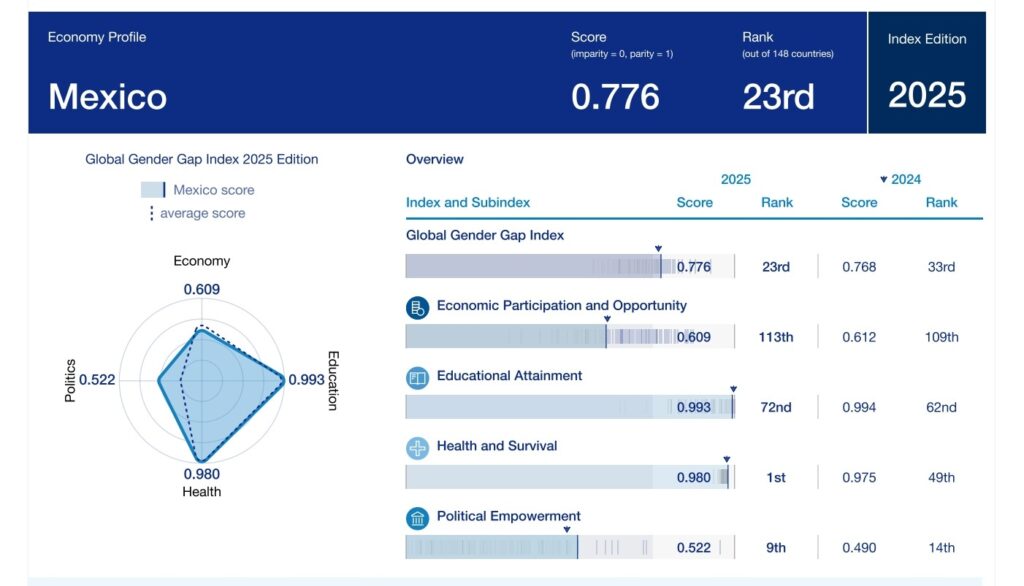
Mexico made a significant leap forward in the 2025 edition of the Global Gender Gap IndexThe country climbed from 33rd to 23rd place out of 148 economies, with a score of 0.776 on a scale where 1.0 represents full parity.
This gain of 10 places and 0.008 points over 2024 was driven mainly by notable achievements in political empowermentan area in which the country has become a regional and global benchmark.
With this result, Mexico ranks among the five best positioned countries in the world in the Latin America and the Caribbeanonly behind Barbados, Costa Rica, Nicaragua and Chile, and above the regional (74.5%) and world (68.8%) average.
Female representation, key to promotion
The performance of Mexico in the subscript of Political Empowerment was outstanding, ranking 9th globally with a score of 0.522, almost 20 points above the Latin American average (35%) and more than double the world average (22.2%).
The report highlights three milestones that have been key to this result:
- The total parliamentary parity that Mexico has maintained since 2022.
- Closing more than 80% of the gender gap in ministerial positions for the first time by 2025.
- The election of Claudia Sheinbaum Pardo as the first woman president of Mexico at the end of 2024.
These institutional transformations consolidate the country as an economy that is committed to equitable political representation, in an international context where this dimension still lags far behind.
Stable progress in education and health
In addition to political empowerment, Mexico maintains almost equal levels in education and health. In the sub-index for Educational Achievement scored 0.993 points, while in the Health and Survival reached 0.980, tying with 16 other economies for first place in the world.
Both indicators show a positive stability in recent years and reflect a solid basis for the development of gender equality from an early age.
Economics, the pending challenge
In contrast, the country faces significant challenges in the area of Economic Participation and OpportunityThe country ranked 113th with 0.609 points, below the regional average (65.6%) and just below the global average (61%).
Although Mexico has improved in this dimension since 2006, when it registered only 48% of economic parity, the report notes a slight decline with respect to 2024, mainly due to a drop in the perception of equal pay for similar work, which fell from 52.2% to 51.3%.
In historical perspective, Mexico has advanced steadily, with its overall score rising from 64.6% in 2006 to 77.6% in 2025. This growth is linked to institutional strengthening and public policies that have expanded opportunities for women in different areas.
At the global level, progress toward parity is slow
Globally, the Global Gender Gap Index 2025 reveals that no economy has yet reached full parity. Iceland leads the ranking with a 92.6% closed gap, followed by Finland, Norway and the United Kingdom.
Among the main global conclusions is that, at the current rate, it will take 123 years to close the gender gap completely. The areas of greatest progress continue to be education and health, while political empowerment and economic participation present the greatest challenges.
High-income economies have closed 74.3% of their gender gaps, while middle- and low-income economies are progressing more slowly.
Source: WEF